Where fuel is stored.
The rectangular tank forms the fuel reservoir. An inlet on top provides access, and the assembly connects to the burner area.
Every part has a purpose. Explore the construction shown in our product references, from the integrated reservoir to the twin cooking zones.
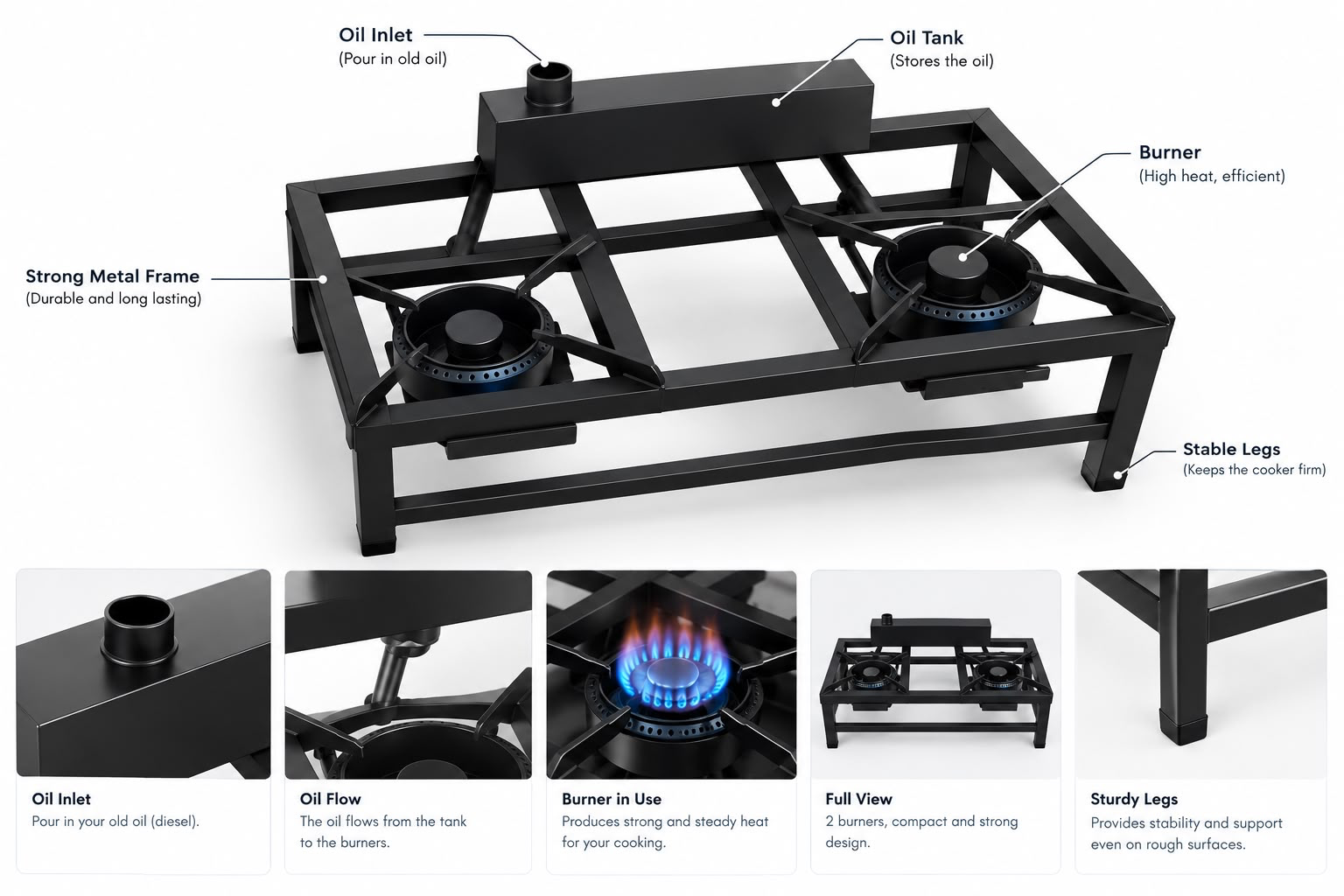
The rectangular tank forms the fuel reservoir. An inlet on top provides access, and the assembly connects to the burner area.
The frame holds two burner assemblies, each with a surrounding pot support. Two cooking zones allow two pots to be positioned at the same time.
Welded metal members form the base and pot supports. Four legs support the unit. Final load limits and dimensions need manufacturer confirmation.
The supplied references describe “old oil (diesel)”; that description is not an approved fuel specification. Burning used engine or diesel oil can release toxic pollutants, and a blue flame does not prove clean or safe combustion. Do not use unverified fuel or treat these pictures as lighting instructions. Obtain the manufacturer’s approved fuel, installation, emissions and operating guidance before use, especially around food or enclosed spaces.
The single-burner cooker offers one pot position; the double-burner frame offers two. The plate-topped heating unit has a different construction and is not yet verified for poultry use. A manual fuel valve does not establish automatic temperature regulation.
Compare the cookersThe photographs show a tank connected to burner assemblies, with a valve for oil flow. The precise fuel-delivery mechanism, lighting method, shutdown process and safety requirements need to be confirmed by the manufacturer.
Potential savings depend on approved fuel price, measured fuel use, cooking time, maintenance and ventilation costs. No verified running-cost measurements have been supplied, so we do not promise savings or publish a percentage.
The pictured unit combines two cooking zones in one frame, integrated fuel storage and simple metal construction. Durability, heat output and operating efficiency require manufacturer testing rather than assumptions from photographs.
Request the approved fuel specification, emissions and safety documentation, instructions, exact dimensions, warranty, delivery costs and a written price.